By Jagdish Prasad Yadav, Senior Occupational Therapist (HSE, since 2004), Founder, Locus Therapy
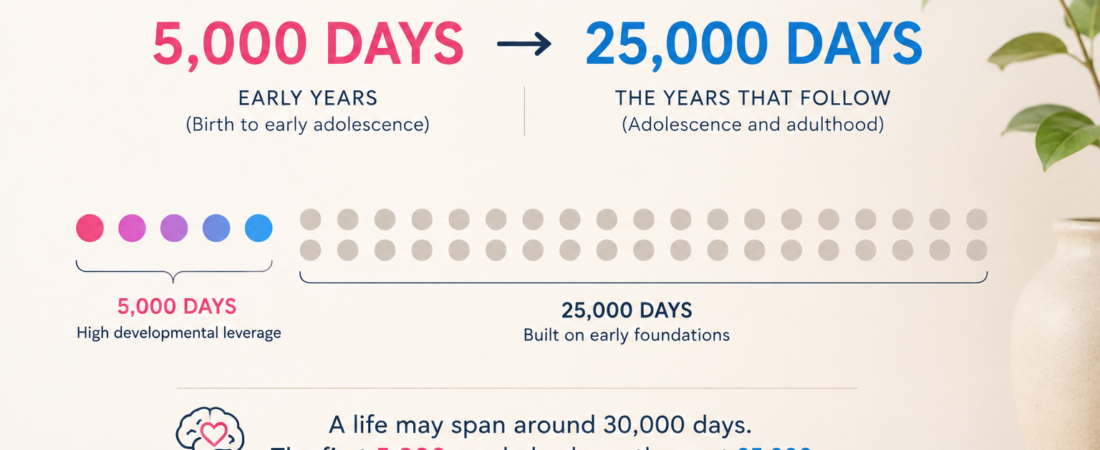
A human life runs to roughly 30,000 days. As OTs, we’re present for nearly all of them — from a newborn’s first reflexes, through every stage of growth, to the last days, and often beyond, supporting a family member still learning how to structure a life around a loss.
But leverage isn’t spread evenly across those 30,000 days. It’s concentrated early — and the research backs this up more precisely than intuition alone would suggest.
The tightest evidence: the first 1,000 days
The most rigorously evidenced window is the first 1,000 days — conception to age two. This period is recognised across global research, policy, and clinical practice as decisive for physical growth and brain development. Harvard’s Center on the Developing Child has documented more than a million new neural connections forming every second during these earliest years — a foundation for everything that follows.
Why the window doesn’t close at two
For a population like Locus Therapy’s — children aged 6 to 16 — the strict 1,000-day framework only tells part of the story. The clinical consensus has shifted: this period is increasingly understood not as a fixed window after which a child’s trajectory is locked in, but as an opportunity to shape development through enriched caregiving, structured support, and targeted therapy.
Self-regulation and executive function — the skills most OT intervention in this age group is built around — keep developing well past toddlerhood. A child’s early regulatory capacity in the preschool years lays measurable groundwork for the executive functioning they rely on at 14 and 15. Researchers studying executive function development now argue for multiple sensitive periods rather than one single window, given how many component skills — inhibition, working memory, cognitive flexibility — feed into it, each maturing on its own timeline.
That evidence base is a fair basis for treating something closer to the first 5,000 days — birth to early adolescence — as the practical window clinicians and parents can still act within, even though it is a broader claim than the strict 1,000-day literature makes on its own.
What’s at stake in catching it
The stakes of intervening inside that window are well documented at a population level. Early intervention during childhood is understood to deliver greater social and individual benefit than intervention introduced later. One of the most cited longitudinal studies in this field found that a child’s level of self-control — assessed young — predicted health, wealth, and public safety outcomes decades into adulthood.
None of this means the door shuts at 5,000 days. The brain remains adaptable well beyond childhood. It means the earlier we’re in the room, the less resistance we’re working against later — and the more a child’s own effort can build on, rather than repair, what came before.
An open question for the field
Every OT and childcare professional who has worked this age range has a version of this story: the child who was reached in time, and the trajectory bent; the child who wasn’t, and the years afterward were spent doing harder, slower work to build what earlier support could have built with far less friction.
Where do you think the leverage really sits inside that window — and what’s the biggest barrier standing between a child and the professionals who could reach them in time?
Take the free Locus Therapy screening to understand a child’s attention, sensory, and regulation profile — and get a graded home programme built around it.
Sources
- The Lancet — The first and next 1000 days: a continuum for child development in early life — https://www.thelancet.com/journals/lancet/article/PIIS0140-6736(24)02439-5/abstract
- Center on the Developing Child, Harvard University — cited via Community Playthings, The first 1000 days — https://www.communityplaythings.co.uk/learning-library/articles/the-first-1000-days
- Developmental Medicine & Child Neurology (Wiley) — The first 1000 days: a critical window for neurodevelopmental trajectories and interventions — https://onlinelibrary.wiley.com/doi/full/10.1111/dmcn.16386
- PMC — Executive Function in Adolescence: Associations with Child and Family Risk Factors and Self-Regulation in Early Childhood — https://pmc.ncbi.nlm.nih.gov/articles/PMC5454452/
- PubMed — Sensitive periods in executive function development — https://pubmed.ncbi.nlm.nih.gov/33457470/
- Moffitt et al., PNAS — A gradient of childhood self-control predicts health, wealth, and public safety — https://ouci.dntb.gov.ua/en/works/7B0DwvJl/