By Jagdish Prasad Yadav, Senior Occupational Therapist (HSE, since 2004) and Founder, Locus Therapy
“Why can’t you just focus?”
It’s one of the most common things said to a child with ADHD — usually out of love, frustration, or both. And it’s also one of the most misleading questions you can ask, because it assumes the problem is effort. It isn’t. ADHD isn’t a shortage of attention. It’s a difference in how attention gets directed.
Here are two simple ways to picture what’s actually going on — one for how attention gets pulled around, and one for why some tasks feel impossible while others feel effortless.
The volume dial that won’t listen
Imagine every brain has a volume dial for incoming information. Its job is simple: turn down the things that don’t matter right now, and turn up the thing that does — the teacher talking, the homework on the desk, the conversation you’re having.
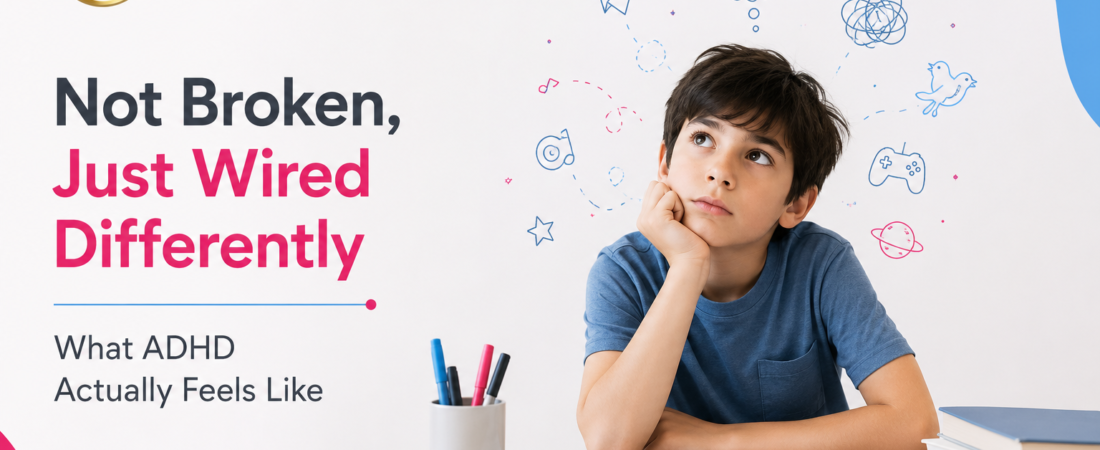
In most brains, that dial responds fairly reliably to importance. In an ADHD brain, the dial doesn’t consistently listen to “this matters.” Instead, everything competes for attention at roughly the same volume — the hum of the fridge, a bird outside, a stray thought, and the maths problem in front of them, all fighting for the same spotlight. Attention doesn’t wander because a child isn’t trying. It wanders because the dial keeps getting pulled toward whatever is loudest in that moment, not whatever is most important.
This is also why sitting still and “just concentrating harder” rarely works as advice. Telling a child with ADHD to try harder to focus is a bit like telling someone to turn up a radio that isn’t picking up the signal properly — more effort doesn’t fix a tuning problem.
The engine that runs on interest, not importance
The second piece explains something parents often find confusing: the same child who can’t sit through ten minutes of homework can focus on a video game or a Lego build for two hours without looking up once.
That isn’t inconsistency or laziness. Psychiatrist William Dodson has described this well: most people run on what he calls an “importance-based” system — a task gets done because it matters, because there’s a deadline, or because of what happens if it isn’t done. Many children (and adults) with ADHD run on something closer to an “interest-based” system instead. Their engine starts reliably for what’s novel, urgent, or genuinely engaging — and struggles to start for a task just because it’s supposed to matter, even when they know it does.
This is a wiring difference, not a discipline problem. A child isn’t choosing to care about Lego more than homework. Their attention system simply responds to different fuel.
Why this matters for how we respond
Once you see it this way, a few things change:
- “Try harder” stops being useful advice, because effort was never the missing ingredient — direction was.
- Tasks that feel impossible to start often become manageable once they’re made more novel, broken into smaller pieces, or given a clearer reason to matter right now rather than someday.
- The child who seems distractible in one setting and laser-focused in another isn’t being inconsistent on purpose. Both are the same brain, responding exactly as it’s wired to.
This reframing matters for adults too. Many parents recognise pieces of themselves in this description — the dial that won’t stay tuned, the engine that only turns over for what’s interesting. ADHD sits on a spectrum that runs through the whole population, not just the children who get formally assessed.
What this looks like in practice
At Locus Therapy, we work with children aged 6 to 16 whose attention, organisation, or self-regulation needs support — often while they wait for face-to-face occupational therapy. Our approach starts with a short screening, which places a child on a graded, home-based programme — Beginner, Intermediate, or Advanced — built around real, structured practice with attention and regulation, not blame or willpower.
The goal isn’t to force a child’s attention system to work like everyone else’s. It’s to help them understand their own wiring well enough to work with it — and to give parents a clearer, kinder lens for what they’re actually watching happen, rather than a battle of effort that was never the real issue.
Take the free Locus Therapy screening to understand your child’s attention, sensory, and regulation profile — and get a graded home programme built around it.
Sources
- Dodson, W. (2025). Secrets of the ADHD Brain. ADDitude Magazine. additudemag.com
- Barkley, R. (2025). Executive Function and ADHD. ADDitude Magazine. additudemag.com
- Arousal dysregulation and executive dysfunction in ADHD. PMC. pmc.ncbi.nlm.nih.gov