By Jagdish Prasad Yadav, Senior Occupational Therapist (HSE, since 2004) and Founder, Locus Therapy
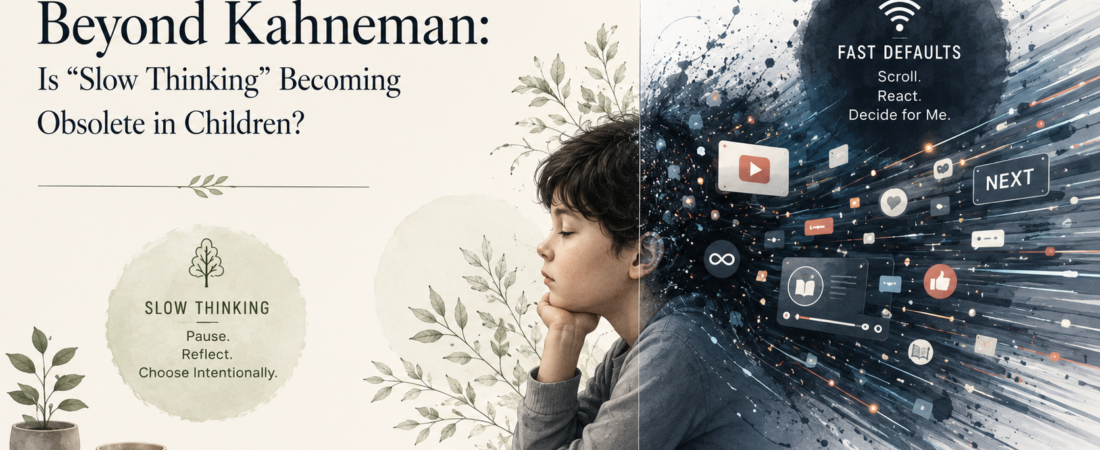
Over a decade ago, psychologist Daniel Kahneman gave the world a simple, powerful way to understand the mind: System 1, fast and intuitive, and System 2, slow and deliberate. System 1 is the snap judgment, the flinch, the answer that arrives before you’ve finished asking the question. System 2 is the pause — the part of us that checks the snap judgment, weighs the options, and decides on purpose rather than by reflex.
For years, that pause was treated as a given. Slower, effortful thinking wasn’t always pleasant, but it was always available, waiting to be switched on whenever a decision actually mattered.
Today, that assumption deserves a second look — especially for children.
A muscle that only gets stronger with use
Deliberate thinking isn’t something a child is simply born with in finished form. It develops the way a muscle does: through repeated, effortful use. Every time a child has to sit with a hard problem, resist an easy answer, or choose between two options instead of taking whichever one is handed to them, that circuitry gets a little stronger.
The part of the brain most responsible for this — the prefrontal cortex, which governs planning, impulse control, and weighing consequences — is also one of the last regions to mature, continuing to develop well into adolescence. During childhood, it is especially responsive to how it’s used. A brain that rarely has to sit in the discomfort of “let me think about this” doesn’t build that capacity as robustly as one that regularly does.
This is exactly the terrain occupational therapy works in: not just what a child can do, but what underlying skills need active building before a task becomes possible.
What today’s digital environment is actually training
Children now spend their days inside systems built to minimise the need for System 2 altogether. Infinite-scroll feeds remove the small decision of “what do I watch next” by making the next thing appear before the last one has even finished. Video content is edited in increasingly short cuts, training the eye and mind to expect a new stimulus every few seconds rather than to sit with one. Automated tutors and recommendation systems increasingly decide, on a child’s behalf, what to read, watch, practise, or try next.
None of these systems are designed with malice. But they are designed, deliberately and skillfully, around a single measurable goal: keeping attention captured for as long as possible. And the most reliable way to do that is to remove friction — which means removing exactly the kind of small, repeated decisions that build a child’s capacity for deliberate thought.
Researchers call this pattern cognitive offloading: using an external tool or system to carry a mental task that a person would otherwise have to do themselves. It isn’t new — writing things down instead of memorising them is a mild, useful form of it, and humans have always offloaded some cognitive work onto tools. Psychologists Evan Risko and Sam Gilbert, whose 2016 review in Trends in Cognitive Sciences helped define the term, describe it as any action that reduces mental load by changing the demands of a task — from altering the environment around us, to setting reminders, to distributing information between people and technology. What’s different now is the scale, the age at which it starts, and who’s doing the deciding. A calculator offloads arithmetic a child has already learned. An algorithm that decides what a child watches next offloads a decision the child hasn’t yet had the chance to practise making.
There’s a second, related shift happening in parallel: attention itself is getting shorter, and not just anecdotally. Researcher Gloria Mark has spent two decades tracking how long people focus on a screen before switching, using objective computer-logging rather than self-report. Her measurements have fallen sharply over that time — from roughly two and a half minutes in the mid-2000s, to about 75 seconds a decade later, to an average of just 47 seconds today. A mind that switches focus that quickly, that often, has very little room left to enter the slower, effortful mode Kahneman called System 2 — because System 2 needs sustained attention simply to get started.
Why the outsourcing habit is riskier for children than adults
An adult who lets a navigation app choose the route, or a streaming algorithm choose the next episode, is offloading a decision on top of decades of already-developed deliberate thinking. The skill exists; it’s just resting.
A child in the same position is in a different situation entirely. If the habit of “let the system decide” forms before the habit of “let me think it through” has had the chance to form first, there’s no fallback skill sitting underneath it. The muscle isn’t resting — it’s underdeveloped. And the years when that muscle is most trainable are exactly the years increasingly spent inside systems built to bypass it.
This matters well beyond screen time itself. A child who has had limited practice sitting with a hard decision will often struggle in the same way with an unfamiliar homework problem, an ambiguous social situation, or a multi-step task at school — not because they lack intelligence, but because the specific skill of tolerating “I don’t know yet, let me work it out” hasn’t been exercised enough to feel manageable.
What this looks like in practice
At Locus Therapy, we work with children aged 6 to 16 whose attention, organisation, or self-regulation needs support — often while they wait for face-to-face occupational therapy. A recurring thread across many of these children isn’t an inability to think things through. It’s that they’ve had very little practice doing it, because so much of their day is structured by systems that think for them.
Our approach starts with a short screening that places a child on a graded, home-based programme — Beginner, Intermediate, or Advanced — built to rebuild exactly this kind of deliberate capacity through real tasks, not screen substitutes. The goal isn’t to remove technology from a child’s life. It’s to make sure the slower, more effortful kind of thinking still gets exercised regularly enough that it stays available when it’s genuinely needed — for a hard test question, a difficult friendship, or a decision with real consequences.
A question worth sitting with
Kahneman’s framework wasn’t a warning about technology — it was a description of how minds work. But it was built on an assumption that both systems would keep getting used. For today’s children, that assumption can no longer be taken for granted.
As a parent, educator, or professional, have you noticed fast-paced technology changing how the children in your life sit with a hard problem? And what does protecting a child’s slow-thinking capacity look like in a world built to move fast?
Take the free Locus Therapy screening to understand your child’s attention, sensory, and regulation profile — and get a graded home programme built around it.
Sources
- Kahneman, D. (2011). Thinking, Fast and Slow. Farrar, Straus and Giroux.
- Risko, E. F., & Gilbert, S. J. (2016). Cognitive Offloading. Trends in Cognitive Sciences. sciencedirect.com
- Mark, G. (2023). Attention Span: A Groundbreaking Way to Restore Balance, Happiness, and Productivity. Hanover Square Press. Summary via University of California
- Steelcase, Work Better podcast, “Our 47-Second Attention Span With Gloria Mark.” steelcase.com