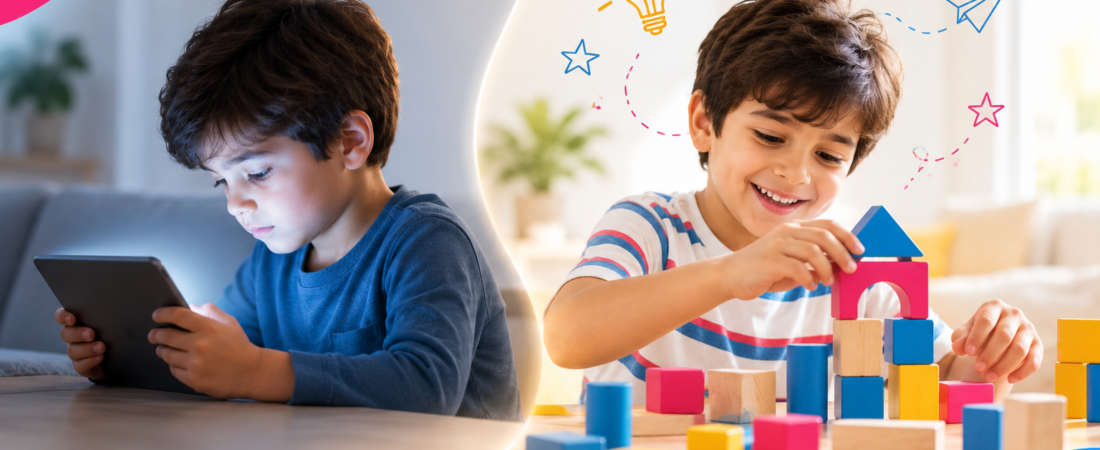
Why free, unscored play matters for your child’s flexible thinking, and for yours.
By Jagdish Prasad Yadav, Senior Occupational Therapist (HSE, since 2004) and Founder, Locus Therapy
We usually think of ageing as something that happens to the body. But after more than twenty years as an occupational therapist, working with children and adults, I’ve come to believe it starts somewhere quieter: the day a person stops playing, and more specifically, the day their thinking stops bending.
I don’t mean the day we stop having fun. I mean the day we stop playing in the older, almost forgotten sense: doing something with no scoreboard, no streak to protect and no outcome to optimise.
For parents, this isn’t an abstract idea. It shapes how our children learn to handle change, frustration and the unexpected, and it is under more pressure now than ever before.
| KEY TAKEAWAYS Cognitive flexibility, the ability to shift your thinking when things change, is a better sign of a “young” mind than age.Free, unscored play is one of the best-evidenced ways to build it, in childhood and beyond.Personalised feeds are designed to show us more of what we already like, which is the opposite of what flexibility needs.Small, daily doses of open-ended play at home make a real difference. |
Even our leisure has a scoreboard now
In a recent Aeon essay, “More Nothing Now”, Justin Neuman names something many of us feel but rarely say out loud. Our sleep gets tracked and our calm gets scored. Meditation apps reward stillness with streak counters, and language apps hand out badges for what used to be simple curiosity. Free time, he argues, has quietly turned into another job, complete with targets and guilt.
He opens with a scene many parents will recognise. His children were meant to be playing the strategy board game Catan. Instead, they pulled the board apart and built an entirely new world from its pieces: islands, bridges and a purpose the game’s designers never imagined.
Neuman draws on a distinction from the French sociologist Roger Caillois. You can play a game: follow the rules, chase the win and measure yourself against an opponent. The Greeks called this agôn. Or you can play in a game, the way his children did, which Caillois called paidia: free, spontaneous and unscored. One is competition. The other is much closer to what occupational therapists mean when we talk about play.
Play is not something we grow out of
In occupational therapy, play isn’t a “kids’ activity” we graduate from. It is one of the core human occupations, alongside self-care, work and rest, that people need across their whole lives to stay engaged, regulated and well.
The paediatrician and psychoanalyst Donald Winnicott went further. He argued that the capacity to play freely, meeting the world creatively rather than simply complying with it, is what makes a person feel that life is worth living. Without it, he warned, people can end up living “as if caught up in the creativity of someone else, or of a machine.” He wrote that in 1971, decades before the smartphone.
That is not only a childhood problem. It is a lifespan one. But childhood is where the habit is built.
Rigidity, not years, is the real marker of age
Here’s a reframe worth sitting with. A person’s age is a fairly poor guide to how “old” their thinking seems. What tracks more closely is rigidity: fewer new ideas entertained, opinions that stop updating, and a shrinking willingness to try the unfamiliar.
Researchers call the opposite quality cognitive flexibility: the brain’s capacity to shift strategy when a situation changes. It is part of executive function, the same set of skills that helps a child move between tasks, cope when plans change and find another way through a problem.
It is also one of the most closely studied markers of brain ageing. A 2023 study in Frontiers in Neuroscience found that older mice struggled more than younger mice when a familiar task was changed, and that their flexibility tracked with how many new neurons their brains were producing. Encouragingly, the older mice narrowed the gap with extra training. Human research points the same way: a 2019 paper in Applied Neuropsychology: Adult reported that flexibility varies widely between people of the same age, with some older adults staying highly flexible and some younger adults showing early rigidity.
In other words, flexibility seems to depend at least as much on how a brain is used as on the number on a birth certificate.
The feed is built to narrow, not widen
This is where the modern feed comes in, and where the picture becomes more urgent for children growing up inside it.
Back in 2011, the author Eli Pariser warned that personalised feeds can trap a person in “a static, ever narrowing version of yourself — an endless you-loop.” Platforms are designed to predict what we’ll engage with next based on what we engaged with before. Almost by design, they show us more of the same.
Previous generations met a lot of shared, unfiltered information by default: the same evening news, the same front page, the same cultural reference points, whatever their personal taste. Today’s children are among the first to have almost every information stream curated for them individually from early childhood, often in hours that used to be filled with undirected, ruleless play.
To be honest about the evidence: no long-term study has yet measured whether this leads to earlier rigidity in today’s children compared with past generations. The research is still catching up with the technology. But the logic is uncomfortable. If flexibility depends on regularly meeting the unfamiliar, and a personalised feed’s whole job is to reduce the unfamiliar, then a child raised inside that feed is practising the opposite skill, earlier and more often than any generation before.
Play is flexibility training, whatever the game
The good news is that flexibility can be built at any age, and play is one of the best ways to build it.
Neuroscientists Sergio and Vivien Pellis, whose work draws largely on animal studies, have reviewed the evidence linking juvenile play, especially the rough-and-tumble, unscripted kind, to the development of the brain’s executive functions, including flexibility. Play works because it forces the brain to improvise, drop a plan halfway through and respond to something it didn’t predict. That is exactly the opposite of what a feed asks of it.
Even something as simple as walking helps. In a 2014 Stanford study, Marily Oppezzo and Daniel Schwartz found that walking boosted people’s ability to come up with many different solutions to open-ended problems by around 60 per cent.
It truly doesn’t matter what the play is. Chess, clay, football, a made-up game with no rulebook, a walk with no destination: anything that asks the mind to bend, rather than confirm what it already expected, counts.
Bringing free play back at home
You don’t need special equipment or a big plan. A few small shifts can make room for the kind of play that builds flexibility:
- Leave some play unscored. Let a board game turn into something else, or build with blocks without the instructions. Resist the urge to steer them back to “the proper way”.
- Protect a little boredom. Short stretches with no screen and nothing scheduled are often where children start inventing.
- Play in, not just alongside. Sit on the floor and follow your child’s rules for a change. When they change the rules mid-game, go with it. That’s flexibility in action.
- Walk without a destination. A wander around the block, the beach or the park, with no step count and no goal, is play for the mind as much as the body.
- Mix up the inputs. Swap the recommended video for a library book they wouldn’t normally pick, a new recipe, or a game from your own childhood.
So: be flexible, play more, stay young
Watch a child stacking blocks, negotiating the rules of an invented game or turning a cardboard box into a spaceship, and you are watching dozens of skills working together at once: movement and coordination, problem-solving, negotiation, frustration tolerance, imagination and language. That is the machinery of flexibility being built, one unscripted moment at a time.
That machinery doesn’t switch off at eighteen. It just gets less practice, unless we deliberately keep giving it some, for ourselves as much as for the children in our care.
Neuman’s essay leaves us with a thought worth carrying forward: play is doing its work even if we’re not keeping score. In the end, age may have less to do with years than with how willing a mind still is to be surprised.
| How Locus can help Locus Therapy supports children aged 6 to 16 whose attention, organisation, sensory regulation or emotional regulation needs support, often while they wait for face-to-face occupational therapy. A short screening places your child on a graded, home-based programme (Beginner, Intermediate or Advanced) built around real, play-based skills rather than screen substitutes. Take the free Locus Therapy screening to understand your child’s attention, sensory and regulation profile, and get a graded home programme built around it. |
References
- Neuman, J. (2026). More nothing now. Aeon, 1 September 2026. aeon.co/essays/play-is-doing-its-work-even-if-were-not-keeping-score
- Caillois, R. (1958/2001). Man, Play and Games. University of Illinois Press.
- Winnicott, D. W. (1971). Playing and Reality. Tavistock Publications.
- Amelchenko, E. M., et al. (2023). Age-related decline in cognitive flexibility is associated with the levels of hippocampal neurogenesis. Frontiers in Neuroscience, 17, 1232670. doi.org/10.3389/fnins.2023.1232670
- Cognitive flexibility in adulthood and advanced age: Evidence of internal and external validity. (2019). Applied Neuropsychology: Adult. doi.org/10.1080/23279095.2019.1652176
- Pariser, E. (2011). The Filter Bubble: What the Internet Is Hiding from You. Penguin Press.
- Pellis, S. M., & Pellis, V. C. (2016). Play and cognition: The final frontier. In Animal Cognition: Principles, Evolution and Development. Nova Science Publishers. nifplay.org summary
- Oppezzo, M., & Schwartz, D. L. (2014). Give your ideas some legs: The positive effect of walking on creative thinking. Journal of Experimental Psychology: Learning, Memory, and Cognition, 40(4), 1142–1152. doi.org/10.1037/a0036577