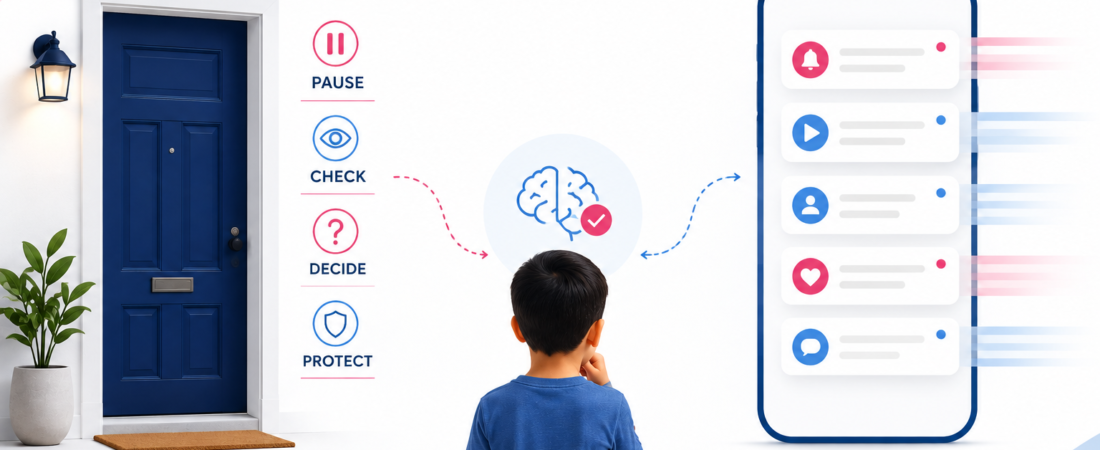
When someone knocks on our door, we don’t fling it open on reflex. We pause. We check who it is, what they want, whether we have the time or energy for them right now — and only then do we decide whether to let them in. It’s an instinct built to protect something valuable: our home, our time, our peace of mind.
Now compare that to what happens the moment we, or our children, unlock a phone. There’s no pause, no filter, no “who’s there?” Every notification, video, opinion, and stranger’s crisis gets instant, unquestioned entry — into the one resource none of us can get back once it’s spent: attention.
The skill hiding inside this habit
In occupational therapy, that pause at the door has a name: inhibitory control — the executive function skill that lets us stop, evaluate, and choose a response instead of reacting automatically. It’s one of the core building blocks of self-regulation, and like any skill, it develops through practice.
The trouble is, a lot of what children interact with today is engineered to remove exactly that pause. Design ethicist Tristan Harris has compared the infinite scroll to a slot machine — a mechanism built to keep pulling you back for one more round, with no natural stopping point. Unlike a front door, the feed was never designed to make anyone ask “should I let this in?” It was designed to make sure they never do.
Why this matters for developing brains
The cost of skipping that pause is measurable, and it isn’t small. A widely cited 2019 neuroscience review, “The Online Brain” (Firth et al.), found that heavy multitasking online is linked to weaker attention control and reduced density in the brain regions responsible for sustained focus. A 2023 meta-analysis in BMC Psychiatry went further, connecting excessive social media use to measurable declines in short-term memory and executive function — the same skills OTs work to build through play, routine, and structured challenge.
For a developing brain, every skipped pause is a missed rep. The gatekeeping instinct at the door doesn’t build itself; it’s practised, thousands of times, until it becomes automatic. If a child’s main daily interaction with information is a feed with no gate at all, that practice simply isn’t happening.
Modelling the pause, on purpose
The good news: this is trainable, the same way any executive function skill is.
- Narrate your own pause. Let your child see you check a notification and decide — out loud — whether it’s worth your attention right now.
- Build in a “who’s there?” moment before screens. A simple habit — ask what they’re about to watch or scroll to, and why — reintroduces the checkpoint the app removed.
- Treat attention like a guest list, not an open door. Talk about what earns a “yes” (something chosen, something useful, something enjoyed on purpose) versus what just walked in because nothing stopped it.
None of this means shutting technology out. It means rebuilding, deliberately, the pause that used to be automatic — for ourselves, and for the children learning to regulate by watching how we do.
Notes on sources used:
- Herbert Simon’s 1971 observation that information abundance creates attention scarcity — the founding idea behind “attention economy” thinking.
- The Economist, “Can you make it to the end of this column?” (Sept 2025) — recent mainstream treatment of attention as an economic resource.
- Firth et al., “The Online Brain” (2019) — neuroscience review on internet multitasking and attention/memory.
- 2023 BMC Psychiatry meta-analysis linking heavy social media use to memory and executive function decline.
- Tristan Harris’s “slot machine” critique of infinite-scroll design (widely referenced in attention-economy discourse, including his Your Undivided Attention podcast).