By Jagdish Prasad Yadav, Senior Occupational Therapist (HSE, since 2004) and Founder, Locus Therapy
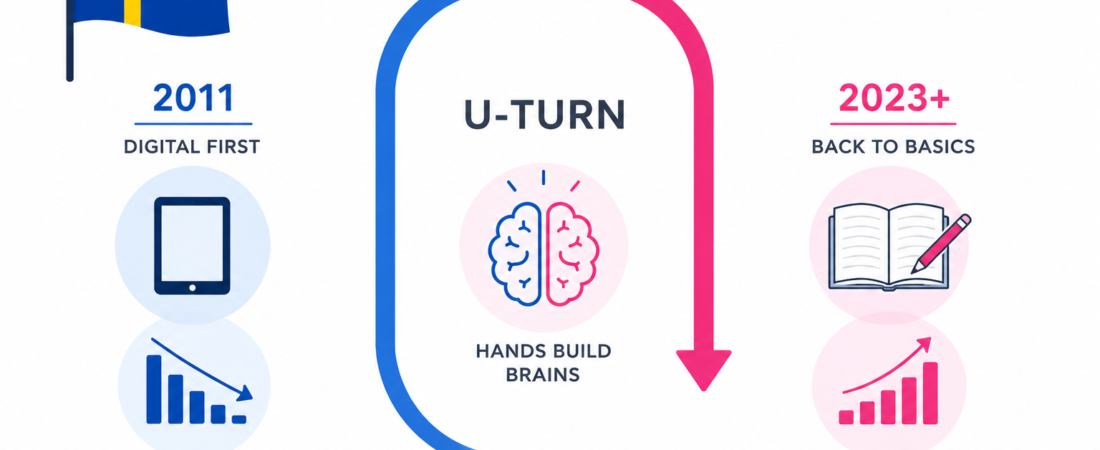
In 2011, Sweden went all-in on digital learning. Tablets entered nurseries. Keyboards replaced pencils. It was held up internationally as the model of a modern, future-ready classroom.
By 2023, the same government was quietly reversing course — buying back paper textbooks by the hundreds of millions of kronor and putting pencils back into children’s hands. This isn’t a culture-war talking point. It’s a country running a decade-long national experiment, watching the results, and correcting itself. As an occupational therapist, what strikes me most isn’t that Sweden noticed a problem. It’s which skill they identified as the one worth rebuilding: handwriting.
What actually happened in Sweden
The retreat has been deliberate and funded, not symbolic. Sweden’s Schools Minister, Lotta Edholm, announced the government would reverse the earlier mandate for digital devices in preschools, with a goal of ending digital learning entirely for children under six. The government backed this with real money — 685 million kronor (around €60 million) committed to printed textbooks in 2023, with another 500 million kronor a year following in 2024 and 2025.
The trigger was measurable decline, not nostalgia. Sweden’s fourth-graders dropped from an average of 555 points to 544 on the Progress in International Reading Literacy Study between 2016 and 2021 — a period that tracks closely with the digital rollout. National exams in primary schools have since been kept deliberately paper-based, and by 2024 the policy had widened into a broader push to cut classroom screen time and address a specific complaint: around 30% of Swedish students said their phones were actively interfering with their studying.
It’s worth being fair to the other side of this. Some education researchers, including Neil Selwyn at Monash University, have pointed out that “blame the screen” narratives are also politically convenient for governments. Sweden’s move isn’t proof that all edtech is harmful — it’s a correction after a specific, hasty rollout, and the country isn’t abandoning technology so much as refusing to let it fully replace the physical tools children’s brains still seem to need.
Why handwriting, specifically
This is the detail that should matter to any parent, and it’s the part occupational therapy has quietly built entire practices around for decades.
Neuroscience research using EEG has shown that handwriting activates significantly more of the brain than typing does — it recruits motor, visual, and language regions simultaneously, producing the kind of widespread neural connectivity linked to stronger memory and learning. The leading explanation is what researchers call “desirable difficulty”: handwriting is slower than typing, so it forces a child to condense, process, and rephrase information rather than transcribe it automatically. That extra friction is where the learning happens.
In fairness, this research isn’t unanimous. Some replication attempts of the earlier, widely cited laptop-notetaking studies have found no advantage for handwriting at all, and a few studies have even found typing outperforms it on comprehension tasks. The honest summary is that handwriting appears to offer a real, biologically plausible advantage for most children — but it isn’t a magic bullet, and the science is still being argued over.
What handwriting undeniably requires, though, is a skill that gets almost no attention in conversations about screen time: visual-motor integration.
The skill underneath the headline
Visual-motor integration — often shortened to VMI — is the coordination between what a child’s eyes take in and what their hands do about it. It’s the skill that lets a child copy a shape from the board, stay inside the lines while colouring, judge how hard to press a pencil, or catch a ball thrown from across the room. Handwriting is really just VMI and fine motor control working together at speed.
This is core occupational therapy territory, and it’s backed by solid clinical evidence. A ten-week OT-designed intervention with kindergartners and first-graders produced significant improvements in visual-motor integration scores, measured on the standard Beery-Buktenica VMI test, particularly among children flagged as at risk for motor difficulties. A broader systematic review of children with developmental disabilities found consistent evidence across multiple studies that occupational therapy intervention reliably improves VMI outcomes. And clinically, VMI deficits aren’t a minor footnote — they’re linked to real difficulty with handwriting quality, which in turn ripples out into reading and maths performance, with estimates suggesting somewhere between 10% and 30% of school-aged children experience handwriting difficulty connected to VMI.
None of this shows up on a parent’s radar when the conversation is only “how many hours of screen time.” A child can be well under every recommended screen limit and still be quietly behind on the eye-hand coordination that most classroom learning is built on top of.
What this means for your child, practically
Sweden’s correction is a useful public data point, but you don’t need a national policy shift to act on this at home. The activities occupational therapists use to build VMI are simple and mostly screen-free:
- Tracing and copying — letters, shapes, simple mazes. This builds the eye-to-hand pathway directly.
- Tactile pre-writing work — playdough, sand trays, chalk on a vertical surface. These build the hand strength and control that come before neat handwriting.
- Catching and throwing — a ball game is a visual-motor task before it’s a sport.
- Puzzles and building blocks — spatial reasoning and fine motor control, developed together.
None of this requires giving up on technology altogether — Sweden isn’t doing that either. It requires making sure that hands-on, eyes-and-hands-together activities aren’t quietly getting crowded out.
Where Locus Therapy fits in
This is exactly the gap Locus Therapy was built to close. We work with children aged 6 to 16 on attention, sensory regulation, and — directly relevant here — the fine motor and visual-motor foundations that handwriting and classroom learning depend on. Many of our families come to us while sitting on long waiting lists for face-to-face occupational therapy. Our short screening places a child on a graded, home-based programme — Beginner, Intermediate, or Advanced — built around the same kind of targeted, evidence-based activity that produced results in the intervention studies above.
Sweden spent over a decade and hundreds of millions of kronor discovering, at a national scale, something occupational therapists have been treating one child at a time for years: the hands still need the work the screen can’t do for them.
Take the free Locus Therapy screening to understand your child’s attention, fine motor, and visual-motor profile — and get a graded home programme built around it.
Sources
- Undark — Why Swedish Schools Are Bringing Back Books
- Careers360 / PTI — Sweden brings more books and handwriting practice back to its tech-heavy schools
- Athens News — Sweden is returning books and pencils to children after twenty years of digital schooling
- Frontiers in Psychology — Handwriting but not typewriting leads to widespread brain connectivity (EEG study)
- Journal of Writing Research — Which modality results in superior recall for students (replication findings)
- NCBI/PMC — Who Benefits from an Intervention Program on Foundational Skills for Handwriting (VMI, kindergarten/first grade)
- Wiley — Systematic Review of Visual Motor Integration in Children with Developmental Disabilities
- Advanced Therapy Clinic — How Occupational Therapy Addresses Visual-Motor Integration